Friday, October 28, 2022

Week Seven and Eight

During weeks seven and eight we learned more insight on common assessment terms such as population, sample, and norming. These terms appear when referring to norm-referenced tests and criterion-referenced tests, the difference between the two being norm- referenced are compared to results of similar groups of people while criterion-referenced are compared to the body of tested knowledge. Continuing with terms commonly used in assessing is the importance of validity which is the whether the assessment measures what it is supposed to measure. Validity goes hand in hand with reliability meaning whether the results can be reproduced under the same conditions meaning can you trust the results. We learned a lot about how to compare scores on excel using terms such as mean, medium, mode, Z-score, and T-score. All of these terms are important to know so that when we receive assessment reports as teachers, we are able to understand the materials and able to explain the information to others. 

            We practiced putting scores into excel to analyze how students were progressing, by making bar/pie charts we can get a simpler breakdown of what students are struggling in what areas or those who seem to be performing above average. Also, it can be used as a reflection on our own instruction, if the whole class struggled in one area maybe consider reteaching the subject before continuing. Excel is a great tool for breaking down assessments and scores to gather intel for future lesson planning’s.


Thursday, October 6, 2022

Week Six

It is important for learning objections to align with standards, instructional activities, and assessments. We first start with the standard since they are what we must teach, while the curriculum can vary it is meant to help you teach the standards. Next, we create an objective that comes from the standard and should be adapted to meet students’ needs. Your assessment should be your objective, by doing this we ensure that what we are asking the students to do is aligning with what we are going to assess them on. By establishing the ABCD’s of the learning objectives we then can decide what assignments, tests, or other assessments you should use. There are multiple ways to assess students learning, by observing how they interact in group, partner and independent work and taking records can help determine where the students are progressing. Exit tickets can be a great way to see what information the students have retained after instruction and can you help you to adjust lessons to the students needs. 

Thursday, September 29, 2022

Week Five

This past week we covered the importance of learning objectives and why we must work to set them up. A learning goal is a statement the teacher writes that describes what the students will be able to do at the end of the lesson. It is important that teachers set their learning objectives to align with there assessments. Since these assessments will measure whether their students are achieving the objectives. If we are not proactive in ensuring that our learning goals, we set for the students match our instructional activities then we will have to make adjustments to one or the other. Misalignment is avoidable as long as we ensure the learning objectives, instruction, and assessments all work together to measure students’ achievement. Learning objectives follow the ABCD formula so that they are clear for the learner, identify what they will be able to do because of instruction, and show how student success will be determined. The A represents who the audience is while the B stands for behavior and is what the students will be able to do. The C stands for conditions which are resources and limitations for performing the behavior, lastly D is degree or level students’ success is determined. Ms. Lauren provided multiple different ways we can assess students both formative and summative. I learned when is best and how is best to give these different types of assessment. 


Wednesday, September 21, 2022

Week Four

During this past week we learned about Bloom’s taxonomy and DOK and the difference between them. Bloom’s taxonomy is organized into six verbs that describe what we want our students to do and serves as a basis for learning objectives, questions, and activities. It is a framework that classifies learning based on different levels of cognitive rigor. Bloom’s taxonomy starts at the bottom with remembering, continuing up with understanding, applying, analyzing, evaluating, and lastly creating. The order of cognitive skills ranging from simple to complex the higher you get the more of a challenge congenitally. Students start at the bottom of the pyramid and much master the lower concepts before they can continue up the hierarchy. 

DOK differs since it only has four sections instead of six. This is a model to analyze how deeply students are thinking to answer questions rather than a framework. Students are able to move fluidly throughout all the stages rather than having to master one skill in order to advance to the next one. I find it focuses more on the activities you can do within the sections and how the students knowledge allows them to complete these steps compared to the students having to master sections in order to move on to the next. In future instruction Bloom’s taxonomy can be used to make sure students work is fitting into each level. We can use this framework to see what type of thinking and reasoning we want our students to know and apply at the beginning of a lesson compared to the end. With DOK I feel like the first three steps would be the most useful during lessons where the students can answer questions. The last level would best work for test like questions and assessments or projects. 

Wednesday, September 14, 2022

Week Three

This past week we learned all about documentation. Documentation can include children’s work in different stages, comments written by the teacher, photographs showing work in progress, and many more. There are different ways to show this documentation like panels, these allow teachers to show how and what their students are learning visually. Another way teachers document is through the use of portfolios, can be displayed as a folder that contains evidence from various assessments. Teachers use documentation as a way to monitor each individual child’s growth and development while holding us accountable to making sure our students are learning. This information isn’t just useful for teachers and students but also parents and administrators who can check on the child’s growth and the teacher’s effectiveness. 

            Some differences between conventional style of documentation and Reggio Emilia’s documentation style is the process of child’s learning, teachers views, and the environment. The teachers take more of a backseat roll in students’ engagement with one another. Watching how they interact with each other instead of leading the engagement. Reggio Emilia’s approach is more formative and looks for the student’s own reflection of learning rather than summative where you only look for the right answer. Reggio Emilia’s approach is more related to students’ growth and development, where conventional looks towards hitting a certain standard or measure. 

            I think after all I learned this week that I will be better able to support students’ knowledge by knowing how to self-reflect on my own documentation. To be able to see where my students are excelling and where they may be struggling induvial and collectively.

Thursday, September 8, 2022

Week Two

This past week I’ve learned a lot about observation and the various types of observing. We observe for many reasons in the classroom such as seeing evidence of students’ knowledge, patterns in their thinking, and helping plan our instructional lessons with their own interest in mind. See observe students’ levels of engagement, interactions, behaviors, and success so that we can reflect on our students development. There are many ways to record these observations as teachers, running records are a detailed narrative description of a sequence of behaviors rather than description of a single incident. Which would be a great way to record your observations of a student during group activities or recess. Another great method is anecdotal which are brief narrative descriptions of a single incident covering what, when, and where. This would be a great way to record an observation you saw a student do for the first time that year. Time sampling is used when there is interest in determining the frequency of a certain behavior occurrences, like how often a student gets distracted during a lesson. 

            We also developed our own rubrics this week and it was more challenging than I thought it would be. It was difficult to distinguish between what is considered a three and a two, since there must be a slight difference in the required work for a better grade. It can be hard to present it clearly to the students what exactly you except from them. In the future I would change our lowest score from labeled as ‘poor’ to something less harsh for some kids to hear. Someone left a comment about how that could come across negatively to a child and I see how that could be

Thursday, September 1, 2022

Week One

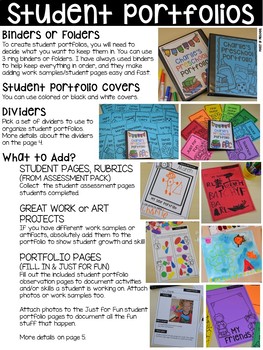
Student Portfolios for Preschool, Pre-K, and Kindergarten | TpT

After week one I learned a lot about the importance’s of assessments and various kinds. An assessment is the process of gathering and documenting ongoing information of a child’s knowledge, behaviors, skill level, or personality. As future teachers we will use these assessments in our own classrooms and should be knowledgeable on the different types there are. We assess for many reasons like monitoring students’ development and learning, to guide our planning and decision making, and to identify children who may benefit form special services. The cycle of assessment is easy to comprehend in the order of teach, gather and assess student work, interpret evidence and identify outcomes, reflect for change and plan for improvement. With formal assessment being more standardized and comparative of performance, although they can be less useful for day-to-day instruction. While informal assessments are more focused on individual performance of students, it shows their weaknesses and strengths. It can be used day to day which is useful for teachers planning and doesn’t require any grading criteria. After assessing our students, we can reflect on their student’s knowledge to see if our own teaching and strategies are successful or not. In my own classroom I plan to utilize all the key aspects of assessments by keeping communication open with the students’ caregivers for how they are outside and inside of classroom. Document their physical, social, and cognitive growth over periods of time. This can be done by observing them in their own induvial work, group work, and whole class participation. Watching how they develop over the course of the year through projects and portfolios would be one of my favorites.  


Week Seven and Eight

During weeks seven and eight we learned more insight on common assessment terms such as population, sample, and norming. These terms appear ...